


Every January, job seekers feel the same pull.
A sense that this is the moment to start over.
That if they just apply more consistently, something will finally click.
New year. New motivation. New promises to themselves.
But January isn’t powerful because people try harder. It’s powerful because companies are under pressure to act — and that pressure rarely shows up on the outside.
What’s Actually Driving January Hiring
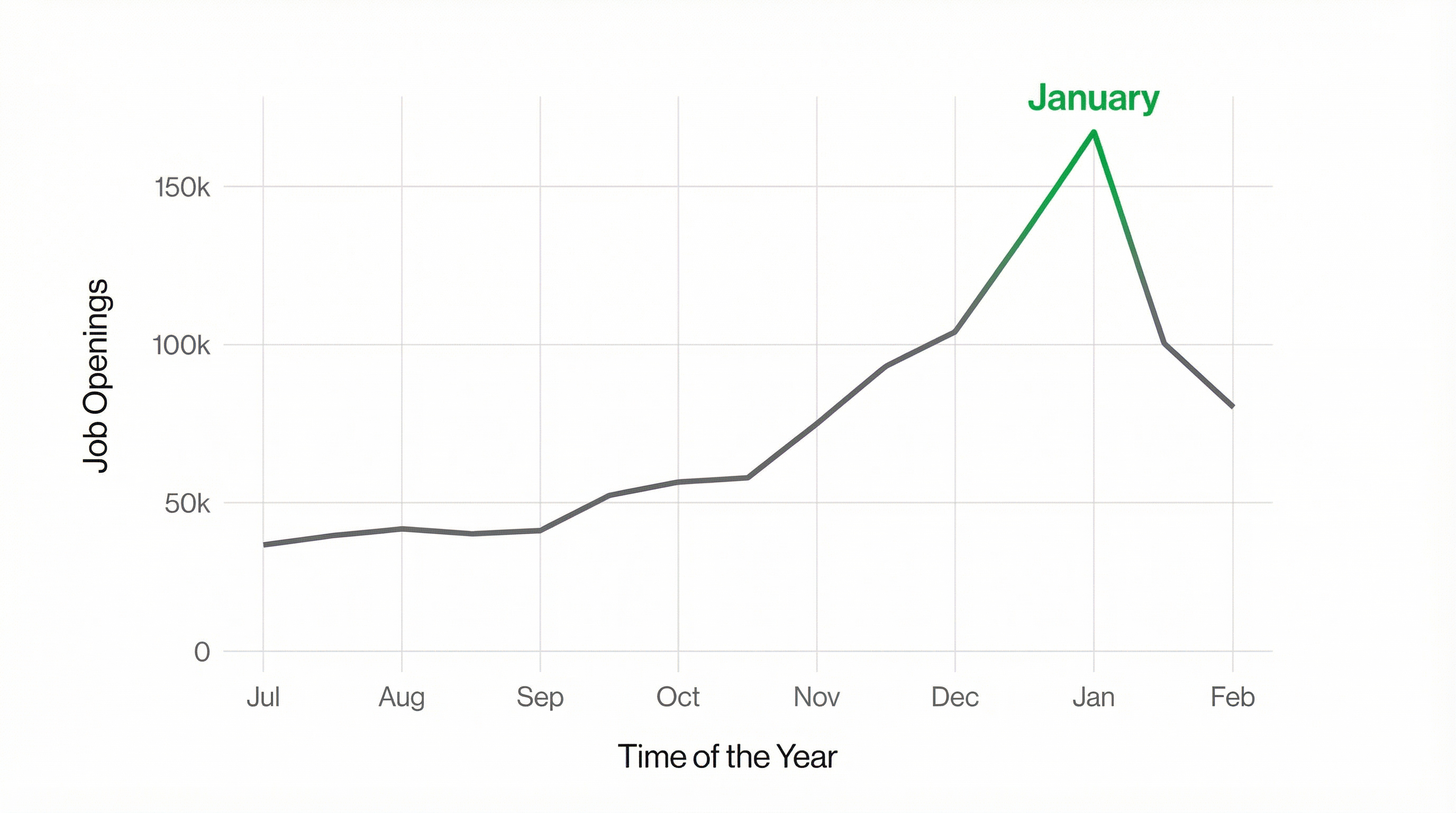
Inside most companies, January marks a reset that isn’t symbolic — it’s operational.
Budgets that were locked all year finally reopen.
Hiring plans approved in late Q4 are cleared to move forward.
Managers who promised leadership they’d rebalance workloads are expected to deliver.
In January, those internal commitments turn into job postings.
That’s why, in January alone, employers publish over 140,000 new job ads — more than a 130% increase compared to late December.
This isn’t optimism.
It’s execution.
Why Job Openings Appear So Quickly After New Year’s
Hiring doesn’t follow motivation.
It follows approvals.
Once budgets reset, companies move quickly to deploy them — especially when teams ended the previous year stretched thin. Roles delayed in Q4 don’t get debated again; they get released.
In some markets, job postings jump over 134% compared to December, and the US follows this same seasonal pattern year after year.
The result is a brief period where opportunity expands faster than competition.
January Hiring Snapshot
- +130% increase in job ads vs late December
- ~48% of professionals say January is the peak month to change jobs
- Hiring momentum remains strongest through January and February, before slowing later in Q1
It’s not a secret window — but it is a short one.
What the January Job Search Usually Looks Like

Despite the surge, most people approach January the same way they approach every other month.
The cycle usually looks like this:
You find a job posting that looks promising.
You tweak your resume to better match the description.
You write a cover letter that tries to sound confident — but not desperate.
Then you submit.
And you wait.
Sometimes for days.
Sometimes for weeks.
Often without hearing anything at all.
If nothing comes back, you assume the problem was your resume — so you rewrite it again for the next role. Another cover letter. Another wait.
January moves fast.
This process doesn’t.
By the time energy dips or life gets busy, dozens of new roles have already appeared — and disappeared — without you ever seeing them.
Why Manual Job Searching Breaks Down in January
The issue isn’t effort.
And it isn’t a qualification.
It’s friction.
January hiring rewards volume and timing, but manual applications demand the opposite.
Most job seekers are stuck with a system that requires:
❌ Rewriting resumes for each posting
❌ Writing cover letters from scratch
❌ Applying to one role at a time
❌ Waiting days or weeks for feedback
❌ Emotionally investing in every single application
That mismatch is why so many qualified candidates miss the January window entirely — not because they weren’t good enough, but because they simply couldn’t keep up.
Common January Job Search Advice (And Why It Falls Short)
When people struggle to get traction, they’re usually told to:
❌ “Customize your resume even more”
❌ “Write stronger cover letters”
❌ “Apply only to roles you’re a perfect fit for”
❌ “Be patient and wait”
❌ “Network harder on LinkedIn”
These strategies aren’t wrong.
They’re just too slow for January.
By the time you’ve perfected one application, hiring managers may already be reviewing shortlists from dozens of others.
How Automation Tools Change the January Equation

This is where the conversation has to shift.
Up to this point, the problem hasn’t been motivation, discipline, or even skill.
It’s been a mismatch between how January hiring works and how most people are forced to apply for jobs.
Manual job searching was never designed for a month where job openings spike suddenly, decisions move faster, and early visibility matters more than perfection.
That’s why January exposes the limits of the traditional process.
Instead of spending hours searching, rewriting, and waiting, automation tools like BetterApply exist specifically to handle high-velocity hiring periods.
They don’t change who you are or what you’re qualified for.
They change how consistently you show up when opportunity peaks.
Here’s how that shift works in practice.
Step 1: Jobs Are Found for You
First, you tell BetterApply what you’re looking for:
- Role type
- Industry
- Seniority level
- Location or remote preference
From there, it continuously finds relevant job openings for you — without you needing to scan job boards every day.No endless scrolling.
No fear of missing new postings.
No mental load.
Step 2: Applications Happen Automatically
Instead of manually rewriting resumes and cover letters for every role, BetterApply handles the application process end to end.
Once your preferences are set, you get:
✅ Role-matched, ATS-optimized resumes tailored to each job posting
✅ Automatic applications submitted consistently across relevant roles
✅ Continuous coverage as new January openings appear
✅ Zero guesswork about what to apply to or when
✅ No interruption to your day — everything runs quietly in the background
Rather than obsessing over individual applications, your presence stays active and steady — exactly when companies are under the most pressure to hire.
Step 3: Consistency Without Burnout
Finally, consistency stops depending on motivation.
Instead of bursts of effort followed by exhaustion, your applications continue steadily — even on days when life gets busy.
That’s the part most job seekers never achieve manually.
Why This Matters Specifically in January
January isn’t forgiving.
Hiring managers are moving quickly.
Shortlists form early.
Visibility matters more than polish.
BetterApply doesn’t promise shortcuts.
It removes bottlenecks.It ensures you’re present across the January hiring surge without turning job searching into a second unpaid job.
The Part No One Talks About: Emotional Distance
One of the biggest advantages has nothing to do with resumes.
It’s psychological.
When applications run quietly in the background, people stop tying their mood to every inbox refresh. They stop over-editing. They stop quitting after a slow week.
They stay neutral — while hiring urgency builds elsewhere.
And that’s often when interviews start appearing “out of nowhere.”
Why This Window Doesn’t Stay Open
January and February carry momentum because budgets are new and teams are still understaffed.
By March, urgency softens.
Roles get filled.
Approval cycles tighten again.
January isn’t magic — but it is leverage.
And leverage only works when you use it early.
Final Thought on Getting Hired Faster
If job searching last year felt heavier than your actual job, the answer probably isn’t more effort.
Especially not in January.
It’s a better system — one that works quietly while companies are already primed to hire.
BetterApply exists for this exact window.
⭐️ LIMITED-TIME OFFER ⭐️
BetterApply is giving a special -60% discount to readers of this article.
To get your discount, click the link below.
Get hired faster with BetterApply
CLAIM YOUR DISCOUNT
I feel this so much. Last year I kept getting ghosted. I’m raising two kids and needed something remote. This January, auto-apply already got me 5 interviews. Fingers crossed for next week 🤞
With how many jobs are out there, applying manually just isn’t realistic if you want to be early. Auto-apply helped a lot.
I fcking hate ghosting recruiters use ATS to filter us out with AI. Only solution is to fight fire with fire and apply with AI